
4 Stages of Wealth Development: What to Do With Your Money


Most money advice fails because it ignores context. “Invest more” sounds great until you’re juggling credit card debt and a checking account balance close to zero. “Pay off debt first” backfires if your retirement account is empty as you near retirement age. The right move depends on your current financial situation.
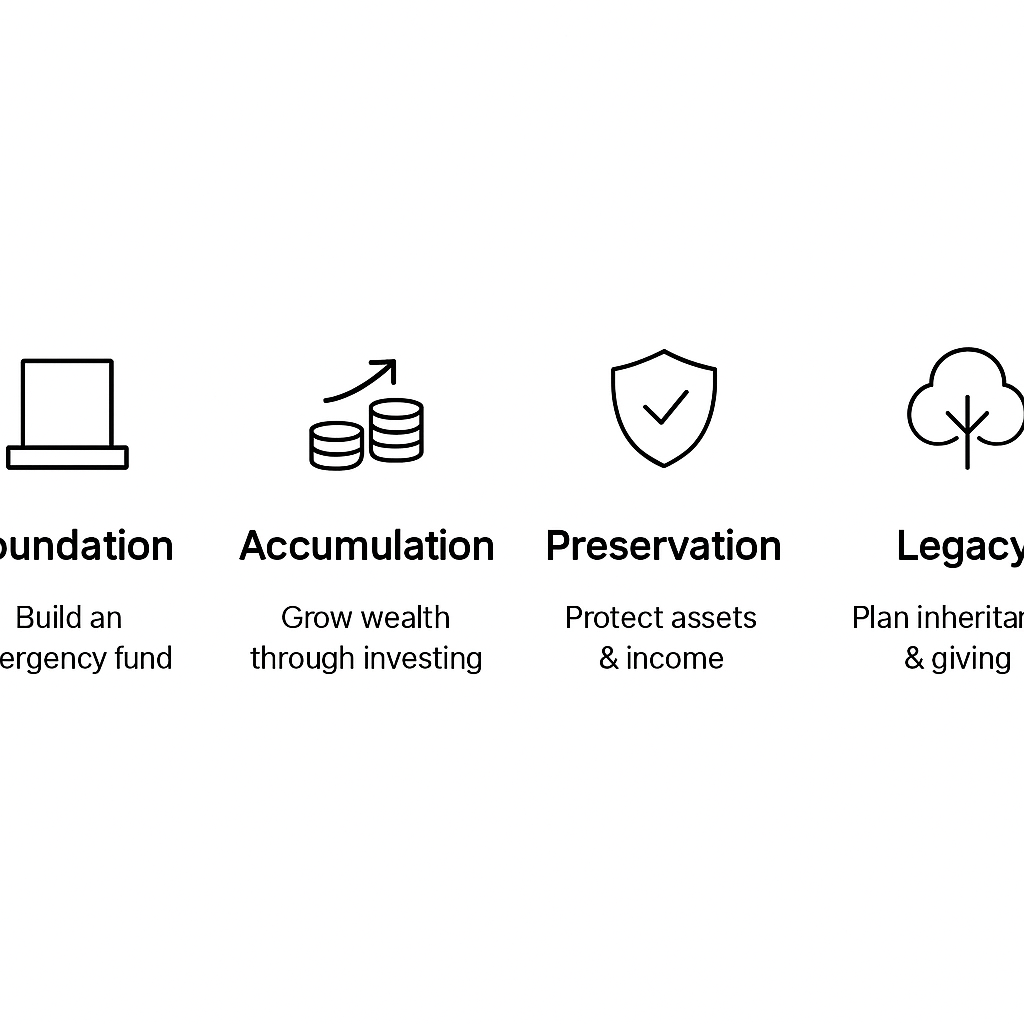
The 4 stages of wealth , Foundation, Accumulation, Preservation, and Distribution/Legacy , provide a clear map for your financial journey. Standard personal finance guidance supports this framework: build an emergency fund before investing, and use withdrawal guidelines as a starting point for retirement. Find your stage, apply the recommended actions, and focus on what matters most for your current financial standing. This guide is current for 2026; where dollar limits change each year, double-check the latest figures before you hit “submit.”
The Quick Answer: 4 Stages and What to Do Next
- Identify your current stage using the checkpoints below.
- Act on the 3–6 key financial moves for that stage before moving to the next.
- Review your stage annually or after major life changes such as a new job, marriage, birth of a child, home purchase, job loss, inheritance, or retirement.
| Stage | Main Goal | Top 3 Actions | Common Mistakes |
|---|---|---|---|
| Foundation | Stability + debt elimination | Budget, eliminate high-interest debt, build emergency fund | Investing before debt is managed |
| Accumulation | Grow net worth consistently | Max employer match, invest in index funds, rebalance annually | Lifestyle creep, delaying investing |
| Preservation | Protect assets, reduce risk | Shift to bonds/cash, tax plan, risk check | Becoming too conservative too early or too late |
| Distribution/Legacy | Sustainable income + transfer | Withdrawal strategy, tax sequencing, estate documents | Rigid withdrawals, forgotten beneficiaries |
Step 1: Spot Your Current Stage
Foundation , Paycheck-to-paycheck, credit card debt growing, no emergency fund, saving seems impossible. This stage indicates a need to establish basic financial security.
Accumulation , Bills are covered, saving consistently, retirement contributions are active, investment horizon is 10+ years. This stage focuses on long-term growth.
Preservation , Substantial net worth, retirement is 5–15 years away, taxes and risk management are priorities over chasing high returns. This stage emphasizes safeguarding existing assets.
Distribution/Legacy , Retired or near-retired, drawing from investments, considering Social Security timing and wealth transfer goals. This stage focuses on sustainable income and estate planning.
Pick the first stage where 2 or more statements are true for you.
Stage 1 (Foundation): Cover Basics, Eliminate Debt, Build a Cash Buffer
Stability is a prerequisite for investing. Emergencies and high-interest debt can negate any investment gains. I once watched a friend invest before building a cash buffer; a surprise car repair erased his “profits” overnight.
Foundation Priorities (In This Order)
- Track monthly essential expenses and minimum debt payments: rent, utilities, food, transport, minimum credit card payments.
- Stop high-interest debt from growing: Credit cards, payday loans. Prioritize paying down the debt with the highest Annual Percentage Rate (APR) first.
- Build a starter emergency fund: Aim for $1,000 or one month of essential expenses, whichever is more feasible initially.
- Automate saving: Transfer 10–20% of your income into a high-yield savings account until you reach 3–6 months of essential expenses.
- Pay down high-interest debt faster: Use the snowball method (smallest balance first) or avalanche method (highest APR first). Choose one and commit.
- Start retirement contributions only after establishing a starter emergency fund and a debt repayment plan. Exception: Always contribute enough to capture any employer match, as this is an strategic, risk-free return.
Emergency fund target: 3–6 months of essential expenses, held in a high-yield savings or money market account. Start with $1,000 if that is realistic.
Budgeting Tools and Apps
| Tool/App | Core Features | Cost |
|---|---|---|
| YNAB | Zero-based budgeting, debt payoff | $14.99/month, $109/year (free for students) |
| Monarch Money | Flexible budgeting, net worth, investment dashboard | Varies, allows household members |
| Copilot | AI auto-categorization, modern design | iOS/Mac only, free trial |
| Goodbudget | Envelope budgeting, manual entry | Free, Premium $10/month, $80/year |
| EveryDollar | Zero-based budgeting | Free, Premium $17.99/month, $79.99/year |
| PocketGuard | “Safe-to-spend” calculation, debt planning | Free trial, $12.99/month, $74.99/year |
| Honeydue | Shared budgeting for couples | Free |
| FreeBudget | Visual tracking, auto-categorization, goal-setting | Free |
Foundation Mistakes That Keep People Stuck
- Using credit cards as an emergency fund.
- Investing while carrying high-interest debt (market returns rarely exceed 20%+ APRs).
- No plan for irregular expenses like car repairs or annual bills.
- Saving manually instead of automating transfers.
- Implementing extreme austerity, leading to burnout and a return to old habits.
Stage 2 (Accumulation): Grow Net Worth With Consistent Investing and Smart Accounts
Once you achieve stability, the most significant drivers of wealth growth are time and consistent contributions, not selecting the perfect investment. Think crockpot, not microwave.
Build an Automatic Investing System
- Contribute enough to capture the full employer 401(k) match. This is always a priority.
- Common Match Structures: Typically, 50% on the first 6% of pay (e.g., if you contribute 6% of your salary, your employer contributes 3%). Other structures include 100% on the first 3% + 50% on the next 2%, or a full 100% match up to 4–6% of pay.
- Illustrative Examples to Maximize Match (assuming a “50% on first 6%” match and under age 50):
- $50,000 Salary: Contribute $3,000 (6%) to receive a $1,500 employer match.
- $80,000 Salary: Contribute $4,800 (6%) to receive a $2,400 employer match.
- $100,000 Salary: Contribute $6,000 (6%) to receive a $3,000 employer match.
- Increase your savings rate gradually. Aim to add 1% every 3 months until you reach 10–20% of your income, depending on your retirement timeline.
- Choose a simple, diversified mix: low-cost index funds covering broad stock markets and bonds as appropriate for your risk tolerance.
- Rebalance annually or when your allocation deviates by 5–10% from your target.
- Use new contributions and dividends to invest in underweight assets before selling anything to rebalance.
| Account | Why It Helps | Watch-Outs | Best For |
|---|---|---|---|
| 401(k) | Pre-tax contributions, employer match, high limits | Withdrawals taxed as income, limited fund choices | Capturing employer match, high earners |
| Roth IRA | Tax-free growth, no RMDs, flexible withdrawals | Income limits, lower contribution cap ($7K in 2025; check current 2026 limit) | Long time horizon, expecting higher future taxes |
| Taxable Brokerage | No limits, flexible access | No tax advantages, capital gains taxes apply | After exhausting tax-advantaged accounts |
Starting Asset Allocation
- Higher risk tolerance (long horizon, 20+ years): 80% stocks / 15% bonds / 5% cash
- Moderate (10–20 year horizon, some nervousness about market fluctuations): 60% stocks / 30% bonds / 10% cash
Diversification helps cushion your portfolio if one asset class performs poorly.
Low-Cost Index Funds
Index funds that track benchmarks like the S&P 500 or total market typically have expense ratios ranging from 0.015%–0.2%. These low fees are crucial because fees compound against your returns over time.
- Vanguard Total Stock Market ETF (VTI): Tracks the U.S. total stock market. Expense Ratio: 0.03%.
- Vanguard S&P 500 ETF (VOO): Tracks the S&P 500 Index. Expense Ratio: 0.03%.
- Vanguard Total International Stock ETF (VXUS): Covers non-U.S. global markets. Expense Ratio: 0.08%.
- Vanguard Total World Stock ETF (VT): Provides broad global equity exposure. Expense Ratio: 0.08%.
- Vanguard Total Bond Market ETF (BND): Tracks the U.S. taxable investment-grade bond market. Expense Ratio: 0.03%.
Market downturns are normal. An automated contribution and annual rebalancing strategy helps mitigate emotional decision-making.
Accumulation Mistakes That Cost the Most
- Waiting for the “right time” to invest.
- Holding too much cash for too long.
- Chasing “hot” stocks or speculative investments with core retirement savings.
- Skipping annual rebalancing.
- Allowing lifestyle creep to consume every salary increase.
- Ignoring tax-advantaged accounts, leading to unnecessary taxes.
Stage 3 (Preservation): Protect What You Built and Reduce Risk
As retirement approaches, protecting your assets becomes more important than seeking aggressive growth.
Shift to a Balanced Mix
- Increase allocations to high-quality bonds and cash as retirement nears. Many near-retirees aim for about 30–40% in bonds, adjusted for individual risk tolerance.
- Hold 1–2 years of essential expenses in safe assets (cash or short-term bonds) to avoid selling stocks during market downturns.
- Diversify across stocks, bonds, cash, and potentially real estate through REIT funds within tax-advantaged accounts.
- Rebalance annually or when allocations drift by 5–10%. Prioritize rebalancing within tax-advantaged accounts to avoid triggering capital gains taxes.
- Example: If you need $30,000 and have a 60% stock/40% bond portfolio, withdraw approximately $18,000 from stocks and $12,000 from bonds to maintain your target allocation.
Risk Check Before Retirement
- How many years until you need to access this money?
- If markets fell by 20–30% tomorrow, would your plan still work? If that thought ruins your breakfast, adjust risk now, not later.
- Are there large upcoming expenses (e.g., college tuition, home repairs, medical costs)?
- Is your emergency fund held in cash, not invested?
- Are you paying fees that haven’t been reviewed recently?
- Do you have adequate insurance coverage for significant financial risks?
Tax Planning Basics
- Place tax-inefficient assets in tax-advantaged accounts (e.g., 401(k), IRA). For example, bond funds generate taxable income and are better suited for these accounts. REITs also generate ordinary income distributions and are often best held in tax-deferred accounts.
- Plan for future tax brackets. Roth conversions in years with lower taxable income can reduce your tax burden in retirement.
- Roth Conversion Scenarios:
- Pre-Retirement Low Income: Convert funds to fill lower tax brackets, e.g., converting $43,500 within the 12% bracket.
- High Earners: Utilize “backdoor” Roth conversions if direct Roth contributions are limited by income. Strategically convert funds to fill higher brackets like 24% or 32%.
- Post-Retirement: Conversions can reduce future Required Minimum Distributions (RMDs) from traditional accounts, allowing for tax-free growth and withdrawals later.
- Variable Income: Use low-income years to make substantial conversions within target tax brackets (e.g., 24–32%).
- Roth Conversion Scenarios:
- Avoid making significant allocation changes based solely on past returns. Use forward-looking financial expectations instead.
Preservation Mistakes to Avoid
- Becoming too conservative too late, or panic-selling into bonds too early.
- Ignoring the effects of inflation on purchasing power.
- Over-concentrating investments in employer stock.
- Neglecting insurance reviews, including long-term care considerations.
- Allowing fees and taxes to silently erode wealth over years.
Stage 4 (Distribution & Legacy): Convert Savings Into Income and Transfer Wealth
This stage focuses on sustainable income, smart tax strategies, and simplifying wealth transfer for your family.
Withdrawal Approach for Retirement
- Start with the 4% rule as a baseline: Withdraw 4% of your portfolio in the first year, then adjust for inflation annually. This rule is designed for a 30-year retirement with a 50–75% stock allocation.
- Adjust for current market conditions: Research suggests a starting withdrawal rate closer to 3.7% for a high probability of success, considering current equity valuations and lower bond yields.
- Use flexible guardrails: Spend less in down years, and more in strong market years. This flexibility prevents exhausting funds or overly restricting spending. Think of it like a thermostat, small tweaks beat big swings.
- Maintain a diversified portfolio, typically 50–60% stocks and 40–50% bonds, depending on individual risk tolerance.
Example: For a $1,000,000 portfolio, a 4% withdrawal means $40,000 in year one, adjusted for inflation annually.
Tax-Smart Withdrawal Order
- Spend from taxable accounts first (brokerage accounts, cash).
- Draw from tax-deferred accounts next (traditional IRA, 401(k)).
- Leave Roth accounts for last, allowing them to grow tax-free for the longest period (and they have no RMDs for original owner).
This order should be adapted based on your tax bracket, Required Minimum Distributions (RMDs), healthcare subsidy eligibility, and income timing.
Add Stable Income Sources
- Delay Social Security if it significantly improves your lifetime income stability; claiming later generally results in higher monthly benefits.
- Consider an annuity only if guaranteed monthly income is a primary goal and you fully comprehend its fee structure and terms.
- Blend income sources (portfolio withdrawals, Social Security, any pension) to create a financial buffer, reducing dependence on market performance for your monthly budget.
Estate Planning Basics
- Create or update a will. This legal document outlines asset distribution and guardian appointments.
- Review beneficiary designations on all retirement accounts and insurance policies. Beneficiary designations override your will; ensure they are current.
- Process: Review statements and online portals. Submit forms with full names, dates of birth, Social Security numbers, relationship, and desired percentage splits for both primary and contingent beneficiaries.
- For trusts: Name the trust as the beneficiary where appropriate. Obtain confirmation and save records.
- Consider a trust if avoiding probate is important or if you need specific control over asset transfer.
- A Revocable Living Trust avoids probate, allows you to manage assets during your lifetime, and can be modified.
- A Testamentary Trust is created by your will and becomes effective upon your death, useful for providing for minors or individuals with special needs.
- A Pour-Over Will works with a revocable living trust to ensure any assets not formally transferred into the trust during your lifetime are moved into it at your death.
- Irrevocable Trusts are for high-net-worth individuals to minimize estate taxes on significant gifts.
- Create a one-page “money map”: List accounts, login information, and key contacts so your family can easily manage affairs.
- Update estate documents after significant life events: marriage, divorce, new child, relocation, major inheritance, or a death in the family. Regularly review the plan every 2–3 years.
Distribution and Legacy Mistakes That Cause Stress
- Taking rigid fixed withdrawals without adjusting for market performance.
- Forgetting to update beneficiary designations after life changes.
- Holding too much cash in retirement, which is eroded by inflation.
- No plan for potential healthcare or long-term care costs.
- Leaving family with disorganized paperwork or unclear instructions.
A Simple Money Moves Checklist by Stage
| Stage | Do This Now | Review Cadence |
|---|---|---|
| Foundation | Budget essentials; stop growth of high-APR debt; open high-yield savings; automate transfers; build $1,000 starter fund. | Monthly until stable |
| Accumulation | Capture employer match; increase savings rate; buy low-cost index funds; rebalance annually; avoid lifestyle creep. | Annually + after raises |
| Preservation | Shift to 30–40% bonds; conduct risk check; review insurance; optimize tax location of assets; plan Roth conversions. | Annually |
| Distribution/Legacy | Set withdrawal rate; use tax sequencing; update beneficiaries; write/update will; build income blend. | Annually + life events |
FAQs
What are the 4 stages of wealth building?
The 4 stages are Foundation (stability and debt elimination), Accumulation (consistent investing and growth), Preservation (protecting what you built), and Distribution/Legacy (sustainable income and wealth transfer). Each stage has distinct priorities.
What is Warren Buffett’s golden rule?
“Never lose money.” This principle highlights that capital preservation is as important as growth. Buffett also advocates for acquiring quality assets at reasonable valuations and holding them long-term, avoiding speculation and unnecessary fees.
What is the average net worth of a 75-year-old couple?
Based on Federal Reserve data, the median net worth for households headed by someone 75 or older is approximately $254,000–$335,000. The average, which is skewed by high earners, is often reported above $1.5 million. The median represents a more typical scenario for most.
What is the 8-4-3 rule for wealth creation?
This rule illustrates the power of compounding. In a consistent investment scenario, money might take 8 years to double, then 4 more years to double again, and then just 3 years for another doubling. It visually demonstrates why early investment is more impactful than larger investments initiated later.
Should I invest or pay off debt first?
Prioritize paying off high-interest debt (anything above ~7–8% APR) first. The primary exception is always contributing enough to capture your employer’s 401(k) match, as this is an immediate, guaranteed return on your investment.
What if I’m between two stages?
Distribute your focus. First, establish stability and ensure basic needs are met. Then, allocate any remaining funds toward investing. You do not need to perfect one stage before beginning the next.
Roth vs. traditional accounts , which one?
Traditional accounts (401(k), IRA) are generally better if you are currently in a high tax bracket and anticipate lower taxes in retirement. Roth accounts are preferable if you are in a lower tax bracket now or expect higher taxes later. Roth IRAs have income limits (phasing out above $165K Modified Adjusted Gross Income for single filers in 2025; these adjust annually, so check 2026 figures), while Roth 401(k)s do not.
Closing: Pick Your Stage and Take One Action This Week
- Foundation: Set up a $25/week automatic transfer to a high-yield savings account.
- Accumulation: Increase your 401(k) contributions by 1%.
- Preservation: Review your last investment statement to check your stock/bond allocation.
- Distribution/Legacy: Verify your beneficiary designations are current on all financial accounts.
Future you will thank you. You do not need to have everything figured out. Identify your current stage and take the next appropriate step. Start there.